Snowmaking infrastructure has turned a seasonal question about precipitation into a permanent one about water rights.
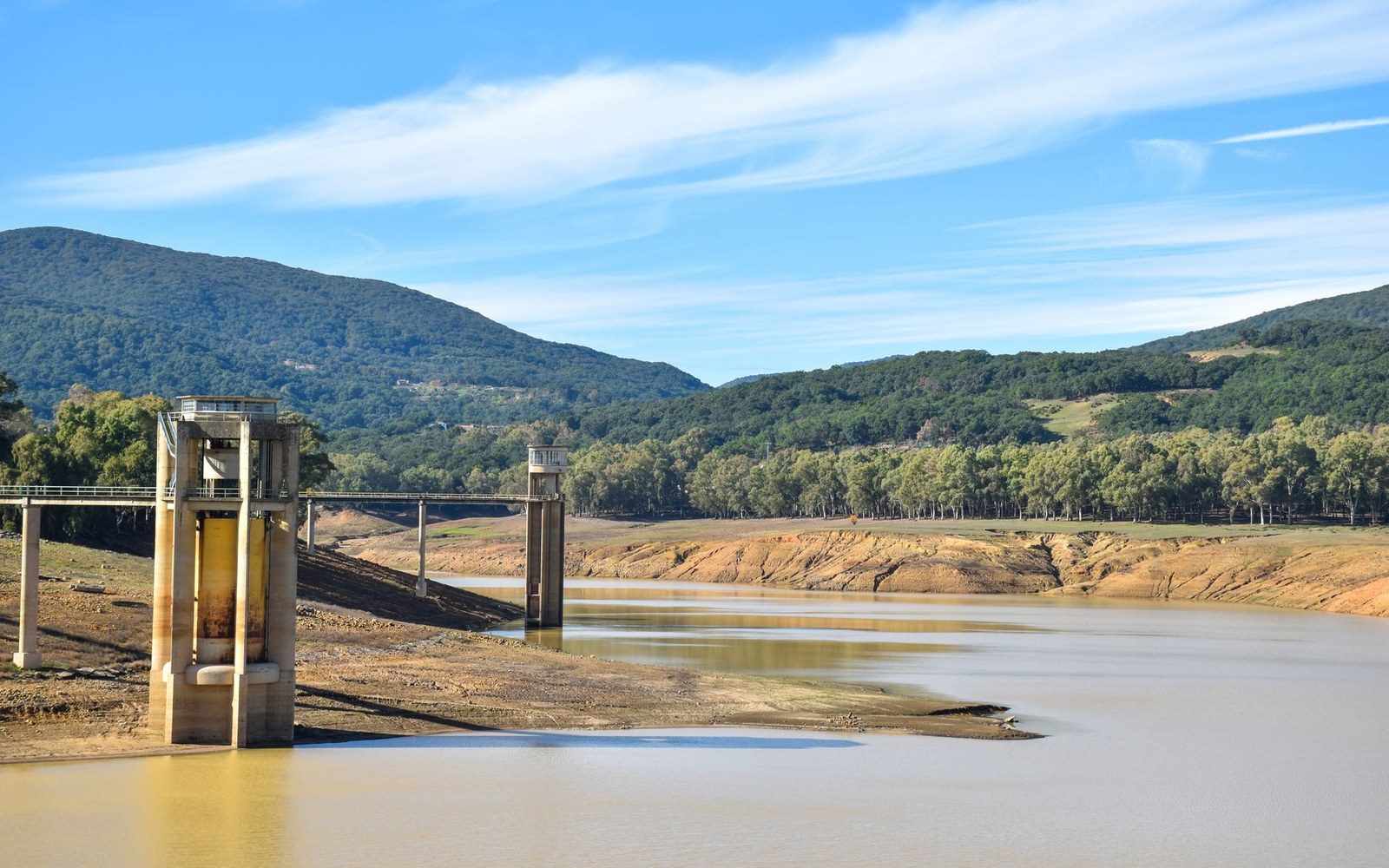
Storage at low water. What the ponds hold in a dry autumn is a question of rights as much as of volume.Photo: DigitalByNADAS Photography / Pexels
What the ponds are and how they work
A retenue collinaire — a hillside storage pond — is not a reservoir in the traditional sense. It is a lined earthen basin, typically cut into a ridge or shoulder at high altitude, designed to capture meltwater and rainfall during spring and summer and hold it for release into snowmaking systems once the season opens. The ponds do not manufacture water; they redistribute it in time. That redistribution, modest when a single pond serves a single run, becomes consequential when dozens of basins draw from the same watershed.
The snowmaking systems they feed are now central to the business model of most large French ski areas. Domaines Skiables de France, the industry body, has documented steady growth in artificially produced snow as a share of opening-day cover across the sector. At many Tarentaise resorts — Courchevel, Val Thorens, La Plagne among them — snowmaking now guarantees the lower runs that connect villages to lift bases, the runs without which a season cannot open commercially regardless of what falls higher up.
A hillside storage pond at the end of autumn. Snowmaking draws on water held here, which is why the ponds are permitted separately from the lifts they serve.Photo: Laura Manzi / PexelsThe turnstile is the instrument behind the industry’s headline figure: it counts passages, not people and not winters.Photo: Harry Dona / Pexels
Who holds the water rights
Water rights in France derive from the Code de l'environnement, which classifies any diversion or storage of surface water above certain volume thresholds as a prélèvement — an authorised abstraction requiring a permit from the prefect of the relevant department. The communes or lift operators behind a retenue collinaire application must demonstrate that the abstraction does not compromise ecological flow — the minimum flow rate that must remain in a watercourse year-round to sustain aquatic life.
That demonstration has become harder to make. Météo-France's Climsnow projections, published as part of its climate scenario work, show that autumn precipitation in the French Alps is becoming less reliable precisely at the period when ponds would normally refill after the summer. A pond designed to be full by mid-November may carry less than two-thirds of its capacity into a dry-autumn season, which then forces earlier drawdown and a longer period of reduced ecological flow downstream.
Permitting disputes have entered the public record in the Isère and Savoie departments, where environmental associations have challenged pond construction or expansion on ecological-flow grounds. The legal route runs through the administrative courts, and decisions have been mixed: some projects have been permitted with reduced abstraction volumes and mandatory flow-monitoring obligations; others have been sent back for supplementary environmental assessment. No single ruling has closed the question across the sector, because each pond is permitted individually against local hydrological conditions.
Where the disputes concentrate
The geographic logic of contention is consistent. Disputes tend to arise where lower-altitude runs are the ones most dependent on snowmaking — because those are also the zones where watercourses are most ecologically sensitive and where downstream agricultural or municipal water users have established claims of their own. Higher basins, above roughly 2,000 metres in the Vanoise and Écrins massifs, sit in more sparsely populated catchments and have faced less organised opposition.
The Parc National de la Vanoise imposes its own constraints: infrastructure within the park's peripheral zone requires additional scrutiny, and the core zone excludes it entirely. Parc National des Écrins operates under comparable rules. These boundaries have in practice pushed snowmaking investment toward the upper edges of the peripheral zones rather than into the fully protected core, concentrating infrastructure — and its water demand — into a narrow altitudinal band that is also the most climatically volatile.
The retenues collinaires question will not be resolved by resort investment decisions alone. The permits that govern them sit with departmental prefects; the legal challenges that test them sit with administrative courts; and the projections that complicate them sit with Météo-France. The ponds hold water that belongs, in law, to no single actor — and that fact is increasingly visible in the disputes around them.