The Games · One track, one country, and four disciplines that need it
A Refrigeration Plant with a Sport Attached
France's only sliding track was built for one Games, kept alive between two, and now sits at the centre of the most expensive single venue question in the 2030 bid.
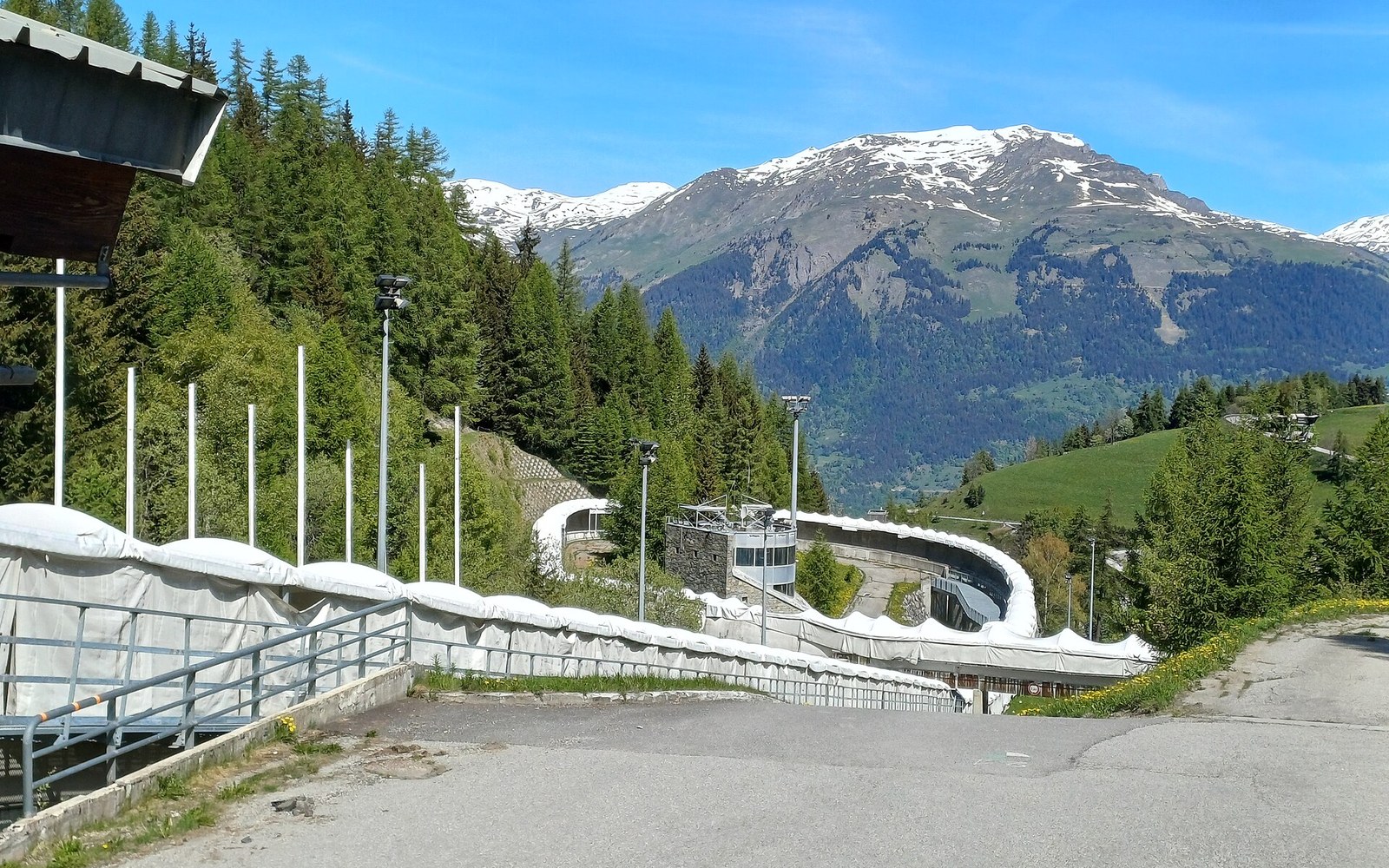
France’s only sliding course: 19 curves, a 144-metre drop, and a refrigeration plant that runs whether or not anyone is competing.Photo: Bobsleigh aux Jeux olympiques de 1992 · Wikimedia Commons
What Was Built and What It Costs to Keep
La Plagne's sliding track occupies the northern flank of Bellecôte, above the resort plateau, at an altitude that keeps its ice reliable through a season — though the ice itself is not natural. A sliding track — a refrigerated concrete course used for bobsleigh, luge and skeleton — is defined by its cooling infrastructure as much as by its shape. The La Plagne circuit, at roughly 1,508 metres above sea level and 1,500 metres in length, was designed for the Albertville 1992 Winter Games and opened for competition in that February. When the Games ended, France chose to keep the track operational rather than decommission it. No other country at that time had built an Olympic sliding track and then simply closed it; the engineering logic of a refrigerated concrete shell makes closure almost as expensive as continued operation, and the sporting constituency — small but internationally recognised — argued successfully for continuity.
The cost of continuity is structural. A sliding track is not dormant between seasons in the way a ski piste is. The refrigeration plant embedded in the concrete must be maintained year-round; ammonia-based cooling systems require permanent technical staff, periodic overhaul, and energy inputs that do not stop when the last sled leaves the finish house. Estimates of annual operating costs for European sliding tracks, including those at Sigulda in Latvia and Königssee in Germany, consistently place the figure in the low millions of euros per year for maintenance alone, before any seasonal ice-making or event hosting is factored in. La Plagne's figures are not published in granular form, but the track operates under a management structure that has historically relied on a combination of national federation support, regional public subsidy, and revenue from training camps and international calendar events.
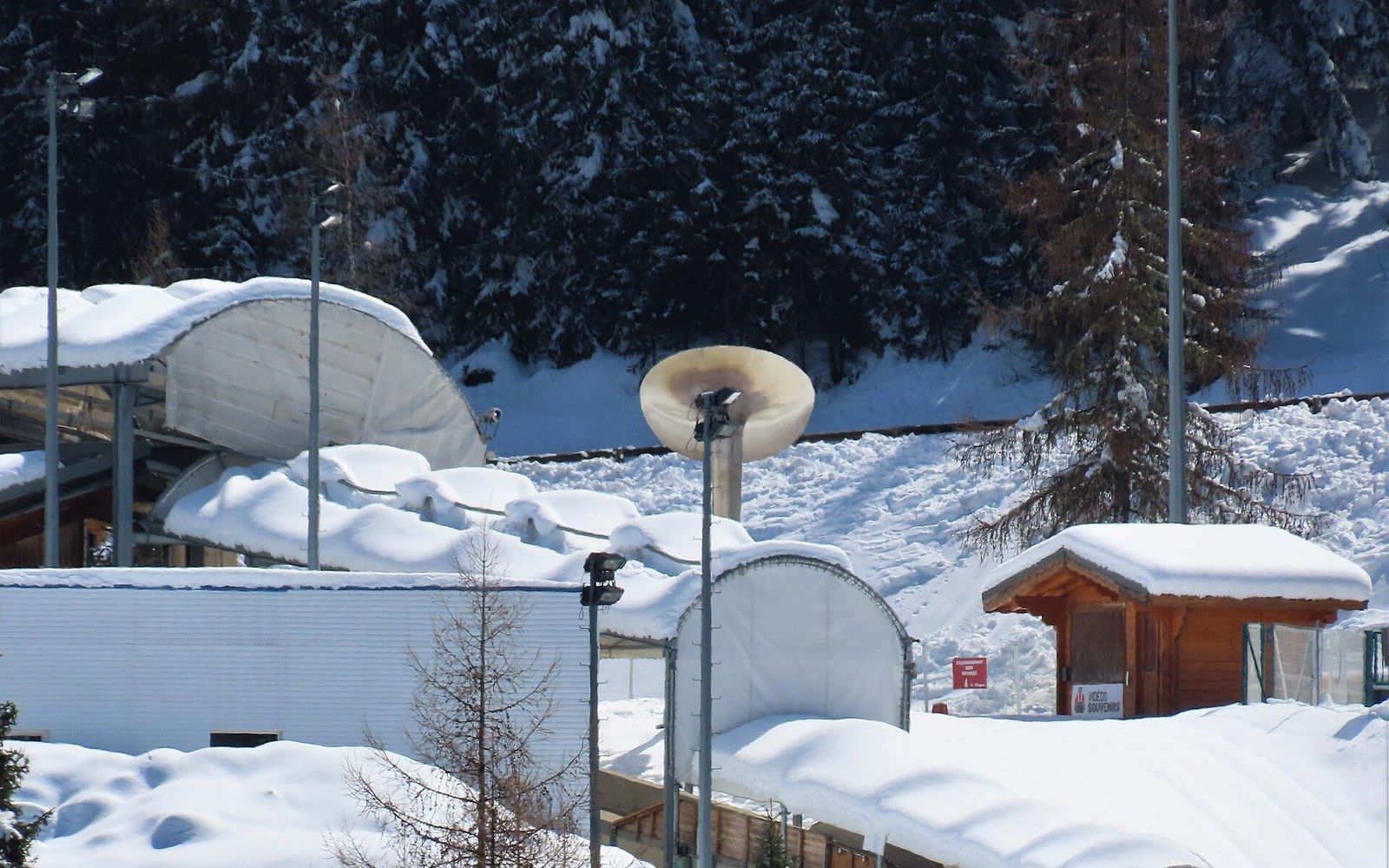
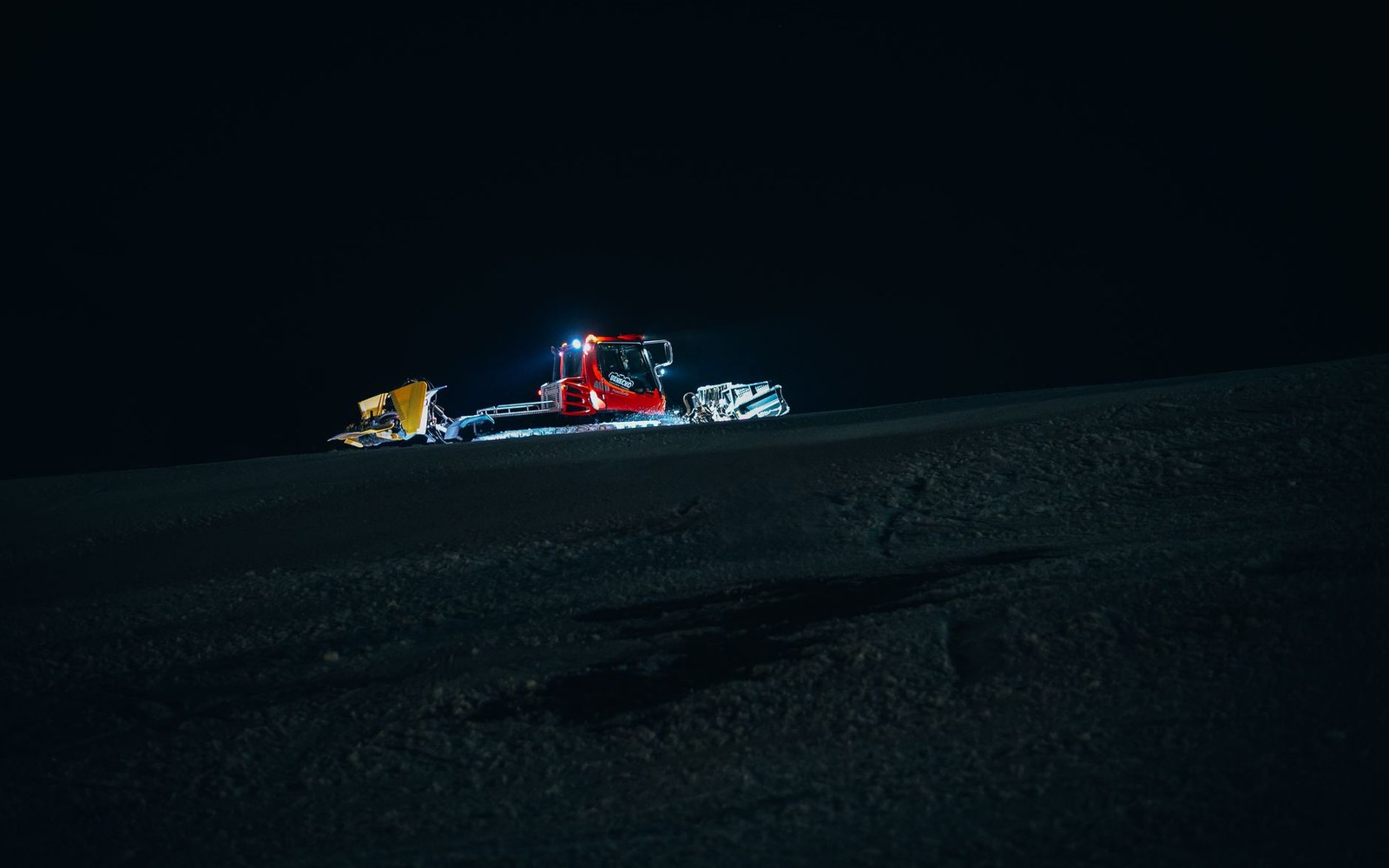
The channel runs about 1,500 metres down the north flank of Bellecôte, refrigerated along its whole length.Photo: Piste de bobsleigh, luge et skeleton de La Plagne 03 · Wikimedia CommonsGrooming begins when the lifts stop. The night shift is one of the largest fixed labour lines in a ski area’s operating budget.Photo: Jan Kopřiva / Pexels
The track holds FIL World Championship and World Cup history. Its 1,508-metre length, 144-metre vertical drop, and 19 curves have been validated repeatedly by the Fédération Internationale de Luge de Course and by the International Bobsleigh and Skeleton Federation for elite competition. That validation record is the asset. Without it, the argument for public subsidy of a refrigeration plant serving a few hundred competitive athletes per season becomes harder to sustain politically.
Between 1992 and 2030
The Albertville 1992 Games were distributed across a wide arc of Savoie venues — La Plagne, Les Arcs, Méribel, Courchevel, Val d'Isère, Tignes, Les Menuires, Pralognan — in a configuration the Cour des Comptes later reviewed critically as a model that diffused investment without concentrating legacy. La Plagne's track was an exception to that pattern: a single-purpose installation of genuine post-Olympic utility, because sliding disciplines have nowhere else to go. A ski slope can host recreational skiers indefinitely; a bobsleigh track cannot become anything else.
The intervening three decades produced a maintenance history that is part engineering record and part political negotiation. Concrete refrigeration tunnels require crack remediation as freeze-thaw cycles stress the structure; the ammonia plant requires replacement on its own engineering timeline; curve profiles are periodically reviewed against updated safety standards. French federal sport budgets, channelled partly through the Fédération Française de Sports de Glace, have contributed to capital works, and Savoie departmental authorities have periodically underwritten operational shortfalls. The track remained on the international competition calendar throughout, which is the minimum condition for continued federation and public support.
The three options and what each costs politically
Refurbish La Plagne
lowest political cost, potentially high engineering cost as work approaches new-build scale
Build new
guaranteed technical compliance, no host government budget commitment made yet, site and planning process unresolved
Hold events abroad
eliminates capital cost, concedes that France's only Olympic sliding facility cannot meet its own Games standards
By the time the International Olympic Committee confirmed the French Alps as host of the 2030 Winter Games at its 142nd session in Paris in July 2024, La Plagne's track was structurally present but in a condition that organisers publicly described as requiring significant investment before it could meet current Olympic standards. That phrase — significant investment — is where the simplicity of having a track and the expense of what to do with it diverge sharply.
The 2030 Question in Concrete Terms
The options circulating for the 2030 sliding events — refurbish La Plagne, build a new track, or hold the events abroad at an existing facility — are each defensible in isolation and each carries a different combination of cost, risk, and political signal. Refurbishment at La Plagne is the option that existing infrastructure nominally supports, but the scale of work required to bring the track to current Olympic technical standards, including refrigeration plant renewal and curve geometry updates, makes the refurbishment cost approach the lower range of new-build costs in some engineering assessments. A new track would guarantee technical compliance but would require a site, a planning process, and a capital expenditure commitment that no French government has formally made. Holding the sliding events at an existing foreign track — Sigulda, Innsbruck, or another FIL-approved facility — would eliminate the infrastructure cost entirely at the price of conceding that France's only sliding venue cannot meet its own Olympic standards.
The Cour des Comptes, France's independent public audit institution, has signalled interest in the overall 2030 budget structure and the division of costs between public and private parties. A sliding track decision carries particular audit exposure because the cost-benefit ratio for a facility used by a statistically tiny competitive population, maintained through decades of public subsidy, is difficult to express in any framework other than national sporting prestige.
The turnstile is the instrument behind the industry’s headline figure: it counts passages, not people and not winters.Photo: Harry Dona / Pexels
What makes La Plagne's track unlike every other 2030 venue question is the absence of a commercial parallel. Ski lifts generate revenue from recreational skiers; the concession model ties private operators to public infrastructure in ways that at least partially justify public investment in access roads and utilities. A sliding track has no recreational users. It is, in the most literal sense, a refrigeration plant with a sport attached — and the sport, however storied its Olympic history at this specific address, cannot pay the cooling bill.
The decision is not yet made. What is made, and what will not be unmade regardless of the 2030 outcome, is the fact of the structure itself: 1,500 metres of refrigerated concrete on a north-facing slope in the Tarentaise, already there, already costing money, waiting for a verdict on whether it is a heritage to be restored or a liability to be resolved.
Track facts
Location
north face of Bellecôte, La Plagne, Savoie
Altitude
approximately 1,508 metres above sea level
Length
approximately 1,500 metres
Vertical drop
144 metres
Curves 19
19
Built for
Albertville 1992 Winter Games
Cooling system
ammonia-based refrigeration, embedded in the concrete structure, requires year-round maintenance