What a Competition Record Provides
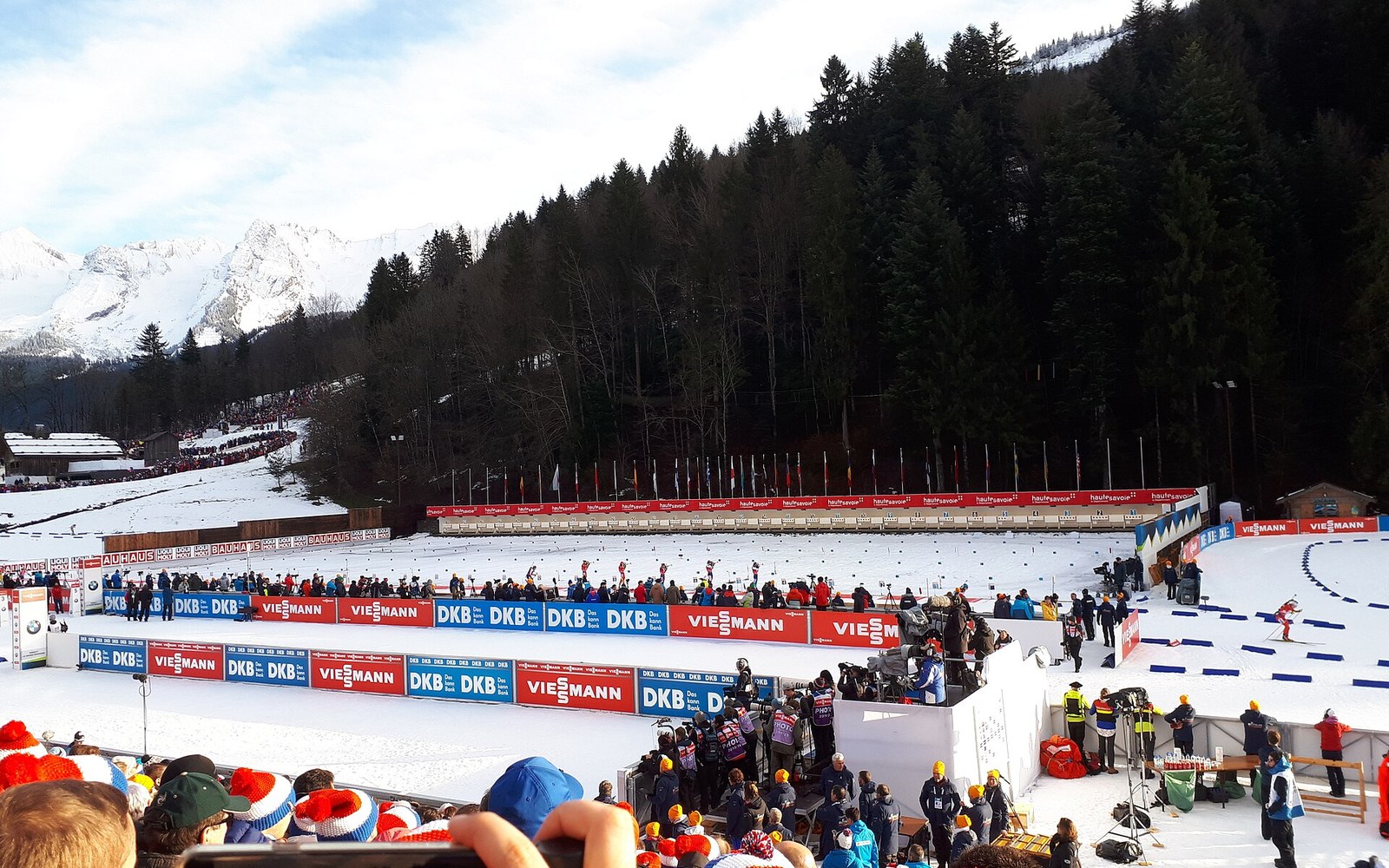
The French Alps 2030 organising committee has assigned Nordic skiing and biathlon events to Le Grand Bornand and La Clusaz, two Haute-Savoie resorts with traceable histories in international competition. Le Grand Bornand has hosted Biathlon World Cup rounds on a consistent basis, providing the infrastructure — a purpose-maintained shooting range, timed loops of certified length, start and finish gantries, and broadcast-ready timing systems — that an Olympic venue must already possess before candidacy is credible. La Clusaz carries a cross-country competition record that reaches back decades and has hosted events on the World Cup circuit.
What a competition record provides, in practical terms, is a body of technical certification that would otherwise have to be created from nothing. The International Ski and Snowboard Federation maintains venue-homologation standards for slope gradient, loop length, altitude, snowmaking coverage and spectator access. A site that has already satisfied those standards for a World Cup — and done so repeatedly, under varying conditions — enters Olympic planning at a materially different point than a greenfield location. The certification work has been done; the snowmaking infrastructure exists; the operational protocols have been tested against real event timelines. Each of those elements carries a cost, and each is absent from a purpose-built site on day one.
Why This Differs from the Plan Neige Era
The Plan Neige — the French state programme of the 1960s that financed purpose-built high-altitude resorts — produced venues like La Plagne and Les Arcs on the model of maximum infrastructure creation. That logic served Alpine disciplines, which require vertical drop and lift capacity, more cleanly than it serves Nordic ones. Cross-country and biathlon are largely terrain- and loop-dependent: the mountain does not need to be remade, it needs to be groomed and certified. Building a new Nordic venue from regulatory zero adds expenditure on homologation, permanent range construction, timing infrastructure and access roads — all of which Le Grand Bornand and La Clusaz already carry on their books as ordinary operational assets.
The Cour des Comptes, France's independent public audit institution, has scrutinised Olympic infrastructure costs in previous Games cycles, and the pattern it identified — venues built for a single event that lack a viable post-Games use — is precisely what the Nordic venue choice is structured to avoid. A biathlon stadium that already hosts World Cup rounds has a post-Games calendar before the closing ceremony. That distinction matters to auditors and to the municipalities that will hold the assets once the organising committee is dissolved.
Snow Reliability at These Altitudes
Both Le Grand Bornand and La Clusaz sit in the Aravis range of Haute-Savoie at altitudes where Météo-France and Climsnow projections on snow-cover reliability are materially more favourable than for lower-lying stations. Neither venue is immune to the rising snow line, but both operate snowmaking infrastructure on their competition loops, and both have demonstrated the capacity to deliver homologated race conditions across a range of meteorological winters. That demonstrated reliability, rather than a theoretical design specification, is the operational argument for venues with a competition history over venues without one.
The practical geography reinforces the institutional logic. Le Grand Bornand lies within reasonable logistical distance of Annecy, which the 2017 merger consolidated as the administrative centre of Haute-Savoie, and which is already embedded in the 2030 organisational structure. Accommodation, transport corridors and media infrastructure already exist in that corridor. A purpose-built Nordic venue elsewhere in the arc would require each of those elements to be created. The venues-budget calculus, in this case, runs firmly in favour of the site that already has a record — and has already proved, under World Cup conditions, that it can use it.